Food Safety Temperatures: The USDA Chart
A food thermometer is the only reliable way to know that meat, poultry, seafood, and egg dishes are safely cooked. Color, texture, and cooking time all mislead. The temperatures below come from USDA, and they're minimums: you can always cook something further for taste.
Safe cooking temperatures
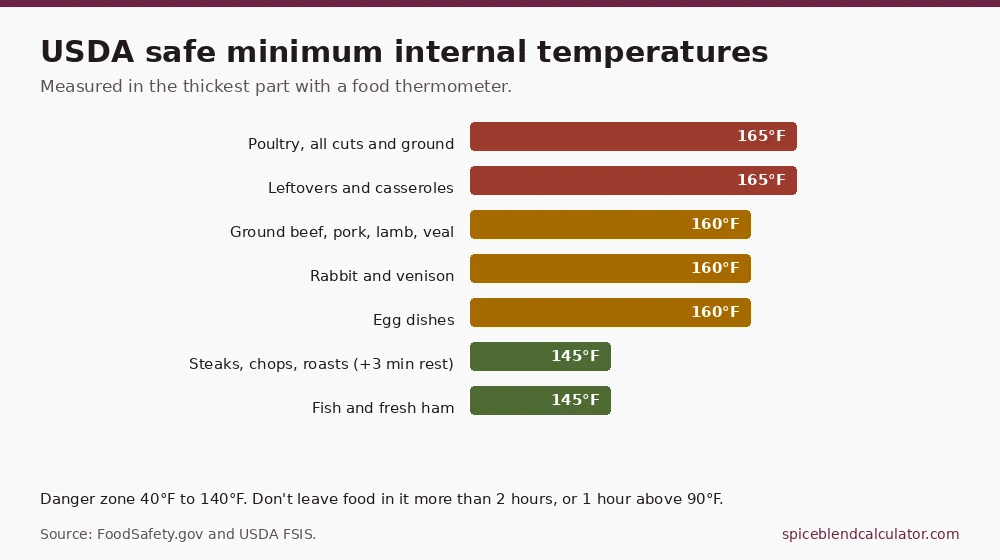
| Food | Safe minimum internal temperature | Rest time |
|---|---|---|
| All poultry: chicken, turkey, duck, goose, and game birds, whole, parts, or ground | 165°F (74°C) | None required |
| Stuffing, cooked alone or in a bird | 165°F (74°C) | None required |
| Beef, pork, veal, and lamb: steaks, chops, and roasts | 145°F (63°C) | 3 minutes |
| Ground beef, pork, veal, and lamb | 160°F (71°C) | None required |
| Ham, fresh or smoked, uncooked | 145°F (63°C) | 3 minutes |
| Ham, fully cooked, to reheat | 165°F (74°C), or 140°F (60°C) if it was packaged in a USDA-inspected plant | None required |
| Rabbit and venison, wild or farm-raised | 160°F (71°C) | None required |
| Fish, whole or fillet | 145°F (63°C), or until the flesh is no longer translucent and separates easily with a fork | None required |
| Shrimp, lobster, crab, and scallops | Cook until the flesh is pearly or white, and opaque | None required |
| Clams, oysters, and mussels | Cook until the shells open during cooking | None required |
| Eggs | Cook until both the yolk and white are firm | None required |
| Egg dishes, such as casseroles and quiche | 160°F (71°C) | None required |
| Leftovers and casseroles, any type | 165°F (74°C) | None required |
| Hot dogs, sausages, and deli meats, when reheating | 165°F (74°C), or until steaming hot | None required |
USDA safe minimum internal temperatures, measured with a food thermometer in the thickest part of the food, away from bone and fat. Source: FoodSafety.gov and USDA FSIS.
Measure in the right place. Put the probe into the thickest part of the food, away from bone, fat, and gristle, and wait for the reading to settle. On thin cuts, go in from the side.
Storage, holding, and the danger zone
| What | Temperature |
|---|---|
| Refrigerator | 40°F (4°C) or below |
| Freezer | 0°F (-18°C) or below |
| Hot holding, keeping cooked food hot | 140°F (60°C) or above |
| The danger zone, where bacteria multiply fastest | 40°F to 140°F (4°C to 60°C) |
| Maximum time in the danger zone | 2 hours, or 1 hour when it's above 90°F (32°C) |
| Oven temperature for roasting meat and poultry | No lower than 325°F (163°C) |
Storage and holding temperatures. Source: USDA FSIS food safety basics.
Bacteria multiply fastest between 40°F and 140°F, which is why food shouldn't sit out longer than two hours, or one hour on a hot day above 90°F. Refrigerate leftovers within that window and use them within 3 to 4 days.
Thawing safely
| Method | What to know |
|---|---|
| In the refrigerator | Safe, and the food can be refrozen afterward. Allow about 24 hours for every 4 to 5 pounds. |
| In cold water | Safe in a leak-proof bag, with the water changed every 30 minutes. Cook it immediately afterward. |
| In the microwave | Safe, but cook it immediately afterward, because parts of the food may already be warm. |
| On the counter at room temperature | Not safe. The outside sits in the danger zone while the middle is still frozen. |
The three safe ways to thaw food, and the one to avoid. Source: USDA FSIS.
Using a thermometer
- Check it in ice water. It should read 32°F (0°C). In boiling water it should read 212°F (100°C) at sea level, and lower as altitude increases.
- Calibrate or replace it if it's off, and test it again after it's been dropped.
- Clean the probe with hot soapy water after every use, especially between raw and cooked food.
- Use an instant-read thermometer for spot checks and a leave-in probe thermometer for roasts and smoking.
Seasoning and food safety
Seasoning doesn't change any of these temperatures. A rub, a brine, or a marinade affects flavor and moisture, not the temperature the food has to reach. Two habits worth keeping:
- Never reuse a marinade that touched raw meat unless you boil it first.
- Season raw meat, then wash your hands before touching the spice jar again, so the jar doesn't become the thing that cross-contaminates your kitchen.
If you're mixing your own rub, the breakfast sausage seasoning calculator works from meat weight, and the blend calculators scale any sourced blend to the batch you need.
Frequently Asked Questions
What temperature is chicken safe at?
165°F (74°C), measured in the thickest part with a food thermometer. That applies to every kind of poultry and every cut, whole or ground.
Why do steaks need a rest and ground beef doesn't?
USDA requires a 3-minute rest at 145°F for whole cuts of beef, pork, veal, and lamb, which lets the temperature finish carrying through the meat. Ground meat goes to 160°F with no rest, because grinding spreads surface bacteria all the way through.
Can I tell if meat is done by its color?
No. Color is unreliable in both directions: ground beef can turn brown before it's safe, and safely cooked poultry can still look pink. A food thermometer is the only way to know.
What temperature should leftovers be reheated to?
165°F (74°C), whatever the food is. Stir while reheating so there are no cold spots, and refrigerate leftovers within 2 hours of cooking.
How do I check that my thermometer is accurate?
Put it in a glass of ice water: it should read 32°F (0°C). In boiling water it should read 212°F (100°C) at sea level, lower at altitude. If it's off, calibrate it or replace it.
This guide covers general food safety for home cooking. For a specific product, follow its package instructions, and for advice about a health condition, follow your doctor or dietitian.
How this was checked
Cedrick Reese publishes this guide for Ready Utilities. Every temperature on this page was checked against USDA during this rewrite: the cooking minimums come from FoodSafety.gov's safe minimum internal temperature chart and USDA FSIS, the storage, danger zone, and thawing guidance from FSIS food safety basics, and the reheating figures from FSIS on leftovers. Figures that weren't USDA guidance were removed rather than reworded. The page is reviewed when USDA updates its charts.