Fresh to Dried Herb Conversion Calculator
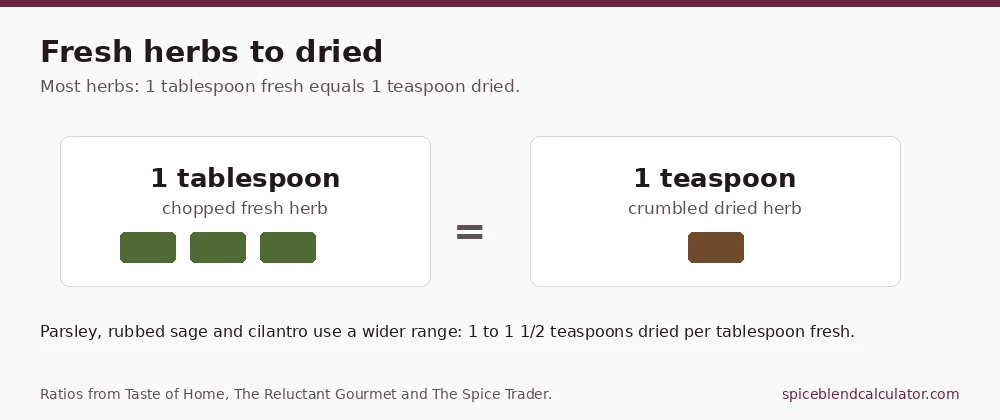
Use 1 teaspoon of crumbled dried herb for every 1 tablespoon of chopped fresh herb, about a third of the volume. Parsley, rubbed sage, and cilantro use a slightly wider range.
Quick answers
Tap an answer to load it into the converter.
Herb converter
Dried herbs are strongest when they're fresh from the jar, so older dried herbs may need a little more. Start with the converted amount, taste, and adjust.
Herb strength varies with variety, age, and storage. Taste and adjust.
On this page
Fresh to dried herb chart
| Herb | 1 tsp fresh | 1 tbsp fresh | 1/4 cup fresh | 1/2 cup fresh |
|---|---|---|---|---|
| Basil | 3/8 tsp | 1 tsp | 1 tbsp + 1 tsp | 2 tbsp + 2 tsp |
| Oregano | 3/8 tsp | 1 tsp | 1 tbsp + 1 tsp | 2 tbsp + 2 tsp |
| Thyme | 3/8 tsp | 1 tsp | 1 tbsp + 1 tsp | 2 tbsp + 2 tsp |
| Rosemary | 3/8 tsp | 1 tsp | 1 tbsp + 1 tsp | 2 tbsp + 2 tsp |
| Marjoram | 3/8 tsp | 1 tsp | 1 tbsp + 1 tsp | 2 tbsp + 2 tsp |
| Tarragon | 3/8 tsp | 1 tsp | 1 tbsp + 1 tsp | 2 tbsp + 2 tsp |
| Dill weed | 3/8 tsp | 1 tsp | 1 tbsp + 1 tsp | 2 tbsp + 2 tsp |
| Mint | 3/8 tsp | 1 tsp | 1 tbsp + 1 tsp | 2 tbsp + 2 tsp |
| Chives | 3/8 tsp | 1 tsp | 1 tbsp + 1 tsp | 2 tbsp + 2 tsp |
| Cilantro | 3/8 tsp to 1/2 tsp | 1 tsp to 1 1/2 tsp | 1 tbsp + 1 tsp to 2 tbsp | 2 tbsp + 2 tsp to 1/4 cup |
| Parsley | 3/8 tsp to 1/2 tsp | 1 tsp to 1 1/2 tsp | 1 tbsp + 1 tsp to 2 tbsp | 2 tbsp + 2 tsp to 1/4 cup |
| Sage (rubbed) | 3/8 tsp to 1/2 tsp | 1 tsp to 1 1/2 tsp | 1 tbsp + 1 tsp to 2 tbsp | 2 tbsp + 2 tsp to 1/4 cup |
Chopped fresh herb to crumbled dried herb. Ratios from Taste of Home, The Reluctant Gourmet, and The Spice Trader. Parsley and rubbed sage ranges from The Reluctant Gourmet; cilantro range spans The Reluctant Gourmet (3 to 1) and The Spice Trader (2 to 1).
Herbs that don't dry well
Cilantro and chives are the two herbs on this list where the dried version falls furthest short. The Reluctant Gourmet rates both as poor swaps: dried cilantro can't reproduce fresh cilantro's bright aroma, and freeze-dried chives hold up better than regular dried ones. The Spice Trader says the mild onion flavor of chives becomes almost imperceptible once dried.
If either herb is central to the dish, like cilantro in salsa or chives on a baked potato, use fresh or pick a different fresh herb. The converter still gives an amount for cooked dishes where the herb plays a supporting role.
How the conversion works
Dried herbs have lost their water, so a smaller volume carries the same flavor. For most herbs, the converter divides the fresh amount by 3 to get the dried amount, and multiplies by 3 to go the other way. Parsley, rubbed sage, and cilantro divide by 2 to 3, which is why their results show a range.
A cup holds 48 teaspoons and a tablespoon holds 3. Results under 3 teaspoons round to the nearest 1/8 teaspoon, and larger amounts round to the nearest 1/4 teaspoon in tablespoons.
Worked example: 1/4 cup fresh parsley
| Step | Value |
|---|---|
| 1/4 cup in teaspoons | 12 tsp |
| Divide by 3 | 4 tsp (1 tbsp + 1 tsp) |
| Divide by 2 | 6 tsp (2 tbsp) |
| Dried parsley | 1 tbsp + 1 tsp to 2 tbsp |
That matches The Reluctant Gourmet's figure of 4 to 6 teaspoons dried parsley for 1/4 cup fresh.
What this converter doesn't cover
These amounts are for crumbled dried leaves. Ground dried herbs are denser and stronger, and the sources don't agree on how to convert them. WebstaurantStore uses 4 parts fresh to 1 part ground, while Dishes and Dust Bunnies uses 2 parts dried leaves to 1 part ground. Until those line up, ground herbs stay off this page.
Seeds such as dill seed and coriander seed aren't the same ingredient as the leaves, so they don't convert either. For garlic and ginger, use the garlic and ginger converter.
How this was checked
Cedrick Reese built this converter for Ready Utilities using the 3 to 1 volume ratio published by Taste of Home, The Reluctant Gourmet, and The Spice Trader, with The Reluctant Gourmet's wider range for parsley and rubbed sage. Cilantro shows a range because those sources disagree on it. Optional gram weights for dried herbs come from USDA FoodData Central. Ratios are rechecked against these pages when the site's data is reviewed.
- Taste of Home: Fresh to Dried Herb Conversion
- The Reluctant Gourmet: Converting Fresh Herbs to Dried
- The Spice Trader: Fresh Herbs vs Dried Herbs
- WebstaurantStore: Fresh vs Dried Herbs
- Dishes and Dust Bunnies: How to Convert Fresh to Dry Herbs
- U.S. Department of Agriculture, Agricultural Research Service, Beltsville Human Nutrition Research Center. FoodData Central.
Frequently asked questions
Does the 3 to 1 rule work for every herb?
It works for most chopped fresh leaves and crumbled dried leaves, according to The Reluctant Gourmet. Parsley and rubbed sage use a 2 to 1 to 3 to 1 range, and bay leaves are swapped one for one by count instead of by volume.
Why does parsley use a range?
Dried parsley varies in strength and density, so The Reluctant Gourmet gives a range of 1 to 1 1/2 teaspoons dried for each tablespoon of fresh.
Can I use ground dried herbs?
This converter covers crumbled dried leaves only. Sources disagree on ground herbs: WebstaurantStore uses 4 parts fresh to 1 part ground, while Dishes and Dust Bunnies uses 2 parts dried leaves to 1 part ground.
When should I add dried versus fresh herbs?
Taste of Home suggests adding dried herbs early in cooking and fresh herbs near the end, when their flavor and aroma come through best.
How do I convert dried herbs back to fresh?
Multiply the dried amount by 3, so 1 teaspoon dried becomes 1 tablespoon fresh. For parsley and rubbed sage, use 2 to 3 teaspoons fresh for each teaspoon dried.