Salt 101: Mastering the Essential Seasoning
Salt is fundamental to cooking, enhancing flavors and bringing out the best in ingredients. Understanding its types and uses can transform your dishes.
Types of Salt
- Table Salt: Fine-grained and often iodized, suitable for baking.
- Kosher Salt: Coarse and easy to pinch, ideal for general cooking.
- Sea Salt: Harvested from evaporated seawater, contains trace minerals.
- Flake Salt: Light and flaky, perfect for finishing dishes.
When to Salt
- Before Cooking: Season meats and vegetables to enhance flavor.
- During Cooking: Add to boiling water for pasta or grains.
- After Cooking: Finish dishes with a sprinkle for texture and taste.
Explore our Spice Blend Calculator to create custom seasoning mixes tailored to your taste.
Salt Equivalents
Salt from different brands and grinds fits into a spoon differently, so the same teaspoon can hold very different weights. Match salt by weight and the saltiness stays the same, whichever salt you use. The table below converts table salt amounts to ten common salts using sourced gram weights.
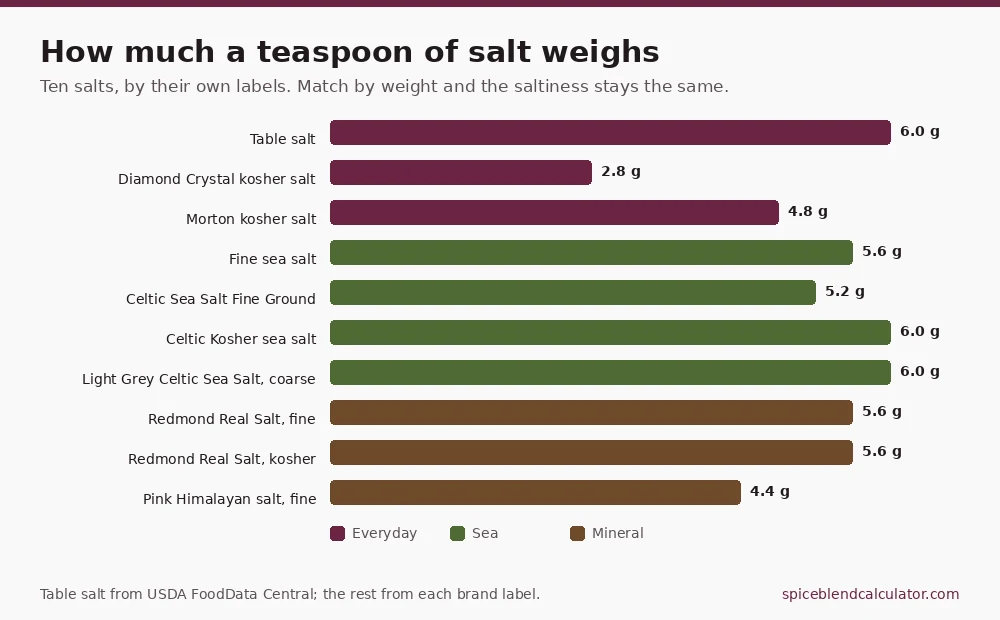
| Salt | Weight per tsp | Matches 1 tsp table salt | Matches 1 tbsp table salt | Source |
|---|---|---|---|---|
| Table salt | 6.0 g | 1 tsp | 1 tbsp | USDA |
| Diamond Crystal kosher salt | 2.8 g | 2 1/8 tsp | 2 tbsp + 1/2 tsp | Diamond Crystal label |
| Morton kosher salt | 4.8 g | 1 1/4 tsp | 1 tbsp + 3/4 tsp | Morton label |
| Fine sea salt (Morton Fine Sea Salt) | 5.6 g | 1 1/8 tsp | 1 tbsp + 1/4 tsp | Morton label |
| Celtic Sea Salt Fine Ground | 5.2 g | 1 1/8 tsp | 1 tbsp + 1/2 tsp | Celtic Sea Salt label |
| Celtic Kosher sea salt | 6.0 g | 1 tsp | 1 tbsp | Celtic Sea Salt label |
| Light Grey Celtic Sea Salt (coarse, moist) | 6.0 g | 1 tsp | 1 tbsp | Celtic Sea Salt label |
| Redmond Real Salt, fine | 5.6 g | 1 1/8 tsp | 1 tbsp + 1/4 tsp | Redmond label |
| Redmond Real Salt, kosher | 5.6 g | 1 1/8 tsp | 1 tbsp + 1/4 tsp | Redmond label |
| Pink Himalayan salt, fine (The Spice Lab) | 4.4 g | 1 3/8 tsp | 1 tbsp + 1 tsp | The Spice Lab label |
Amounts matched by weight to table salt (6.0 g per tsp, USDA FoodData Central). Sea and mineral salt weights come from nutrition label serving sizes, which are rounded, so treat them as close, not exact.
- When a recipe gives salt in grams, weigh it. A gram is the same amount of salt whichever type you use.
- The three Celtic salts carry more moisture and minerals, and their labels list less sodium per gram than the other sea and mineral salt labels in this table, so the same weight tastes slightly less salty. Taste and adjust.
- When a recipe just says "salt" without naming a type, this site treats it as table salt, which is the densest of the common salts and the usual default in American recipes. If the recipe was written with a kosher salt in mind, the result is slightly salty rather than slightly flat.
For any amount, the salt calculators on this site, like the breakfast sausage seasoning calculator, convert between all ten salts.
How this was checked
Cedrick Reese publishes this guide for Ready Utilities. The Salt Equivalents table uses USDA FoodData Central for table salt and nutrition label serving sizes for every other salt, including Diamond Crystal and Morton kosher salt: Morton Fine Sea Salt, Celtic Sea Salt's Fine Ground, Kosher, and Light Grey salts, Redmond Real Salt fine and kosher, and The Spice Lab pink Himalayan salt. Label weights were checked against current product listings, and the guide is reviewed when those labels or the underlying guidance change.